The Emperor’s New Clothes
Vocabulary
| cheer | gorgeous | delightful |
| clasp | long ago | march (2) |
| dwell | empire | rich/richer/richest |
| appear | court (3) | magnificent |
| throne | council | tell/told/told |
| jewel | minister | subject (3) |
| hall | decorate | sculpture |
| fetish | diamond | marine (2) |
| glove | nowhere | sew/sewed/sewn |
| velvet | scarlet | sparkling |
| adorn | sapphire | exquisite |
| ruby | costume | find/found/found |
| pose | deck (2) | one after another |
| suit | parade | square (4) |
| finery | chamber | entourage |
| weave | visible | audience (2) |
| foolish | excited | good/better/best |
| dumb | order (3) | clever/cleverer/cleverest |
| join in | exquisite | make/made/made |
| silk | thread | fine/finer/finest |
| set up | loom (2) | pure/purer/purest |
| tower | fabulous | high/higher/highest |
| lock | progress | send/sent/sent |
| knock | check on | demand (2) |
| let in | pattern | wonderful |
| bold | gesture | report (2) |
| vivid | magical | delightful |
| stupid | promise | stupendous |
| outfit | carry on | hear/heard/heard |
| ready | go by (2) | parade (2) |
| thumb | far away | stand/stood/stood |
| try on | provide | marvelous |
| strip | carefully | gourmand |
| length | trouser | underpants |
| stare | line (3) | procession |
| clap | show off | pay/paid/paid |
| royal | coat (2) | brilliant (2) |
| stun | emperor | turn around |
| laugh | cry out | dumbstruck |
| flush | right (5) | spectacular |
| high | seat (2) | procession |
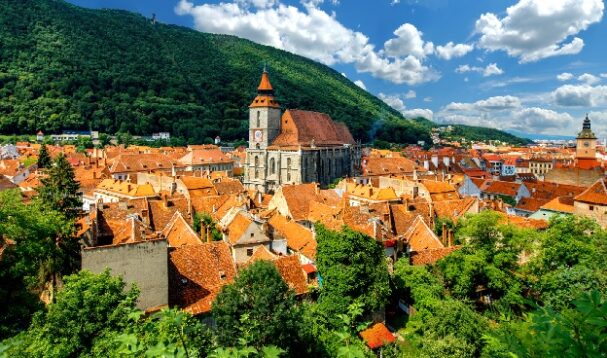
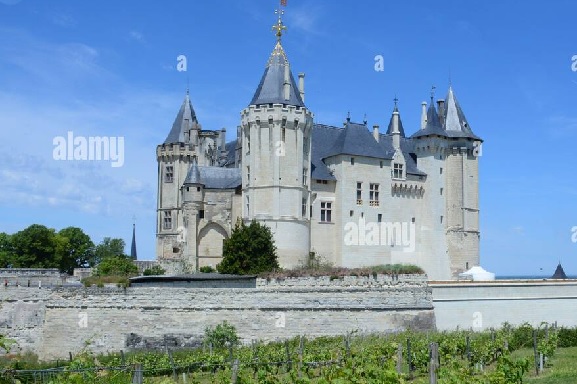
Long ago, far away there lived an emperor. He was the richest man in the land and dwelled in a magnificent castle overlooking his realm.
Court officials seldom told visitors, “The emperor is seated in the throne room,” or “The emperor is in council with his ministers,” for he usually wasn’t.
He did love expensive and beautiful objects: chamber rooms, hall, paintings, sculptures, gold, and jewels.
But most of all he had a fetish for fine, exquisite clothes: hats, gloves, and coats – all sewn from the finest velvets and silks – marine blues, scarlet reds, deep forest greens – and all adorned with sparkling diamonds, sapphires, and rubies.
The emperor could be found posing before his mirror in one new costume after another. He had a suit of clothes for every part of the day.
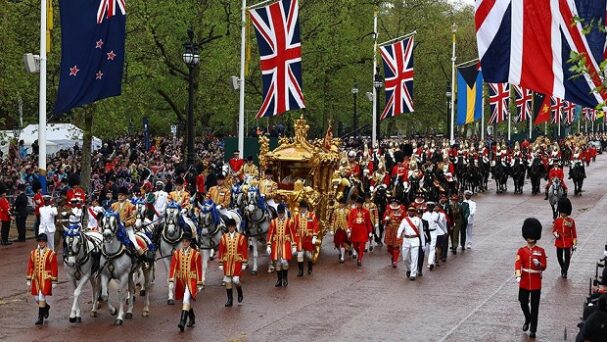
Often he decked himself in finery and parading through the city street and square with his entourage in front of his subjects.
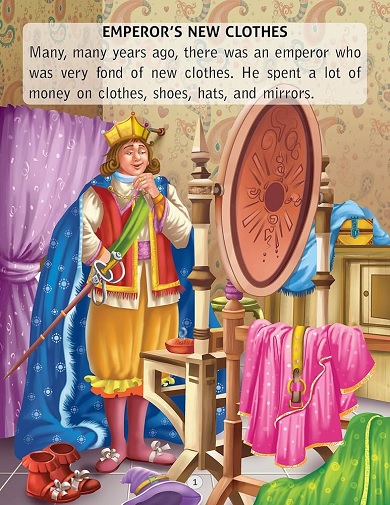
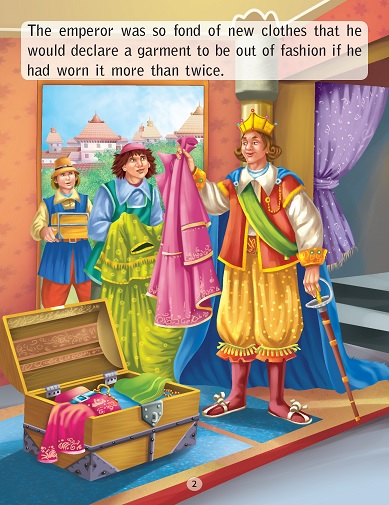
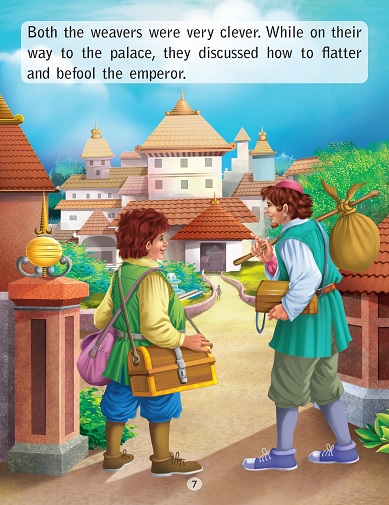
One day two men came to the city, and the castle. They asked for an audience with the emperor. The two men told him they were weavers and they could weave the most magnificent clothes in the land.
What’s more, these were magical clothes, visible only to the best and cleverest of people, and invisible to anyone who was foolish or dumb.
The emperor thought about how magnificent it would be to learn which of his people were clever and who was stupid, and ordered the weavers to make him some new clothes.
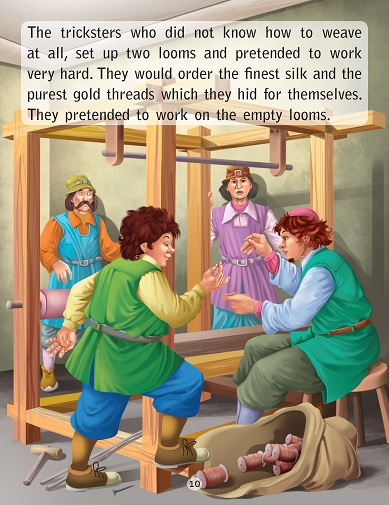
The weavers demanded the emperor provide them with the finest silk and the purest thread, then set up two looms in the highest chamber room of the highest tower of the castle. And be provided with the finest, gourmand food and wine.
When all was provided, the two weavers said they would get to work — and then closed and locked the room door.
A week went by. The emperor then sent his ministers to check on the weavers’ progress. They knocked on the door, and were let in.
“Look at the exquisite, fine weave, the beautiful, bold patterns, and the rich, vivid colours,” the weavers said, smiling and gesturing at the loom.
The ministers looked closely at the loom. And then at each other.
Finally, they said, “Uh . . . Oh . . . It’s . . . It’s wonderful! Yes the weave, the patterns and colours are fine and beautiful, indeed!”
The ministers report back to the emperor, and repeated what the weavers had told them.
Over the following weeks, the emperor sent more ministers to see the weavers at work.
Their report to the emperor was always along the lines of. “Magnificent!” “Delightful!” “Stupendous!”
Soon, everyone in the city had heard about the weavers and their magical clothes, visible only to the cleverest of people. Everyone became very excited and the emperor promised a procession to show off his new outfit.
After ten weeks the emperor was told that his clothes were ready. He went with his ministers to tower and in the chamber room to see them.
The two weavers stood with their arms in the air, their fingers and thumbs clasped together.
The ministers all said, “How marvelous!” How “Fabulous!” “How Spectacular”!
But the emperor looked very carefully. “Uh . . . Uh . . . Yes, indeed . . . They are . . . . very beautiful!”
“Why don’t you try them on?” said one of the weavers.
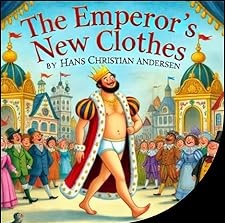
“Er . . . I will,” said the emperor, and he stripped to his underpants.
“First the shirt,” said the weavers, “Then the trousers. Now the coat.”
Everybody stared at the emperor. And them smiled. The emperor smiled. “This is the most exquisite, beautiful clothes in the land!’ he said.
Everybody clapped and cheered.
The emperor told the two men that they were to become the palace’s
royal weavers and paid them both with great bags of gold.
Outside, in the city, the people lined the main street, waiting for the emperor’s procession.
As the emperor arrived and paraded in front of them, everyone stared at them and each other.
At first, there was total silence: nobody said a word.
Then they began smiling and cheering: “Gorgeous! . . . Exquisite! . . . Delightful! . . . Wonderful! . . . Charming! . . . Fabulous! . . . Stupendous! . . . Marvelous! . . . Brilliant . . . Magnificent . . . Splendid . . . ”
This went on for the entire length of the city.
The emperor’s procession reached the end of the street, turned around, and began marching back.
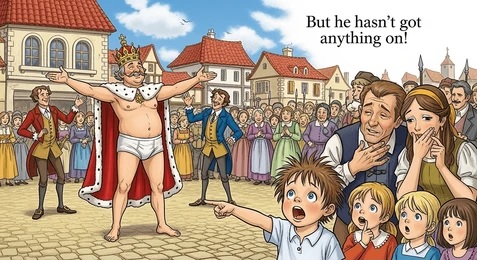
This time, however, a little boy cried out: “But he’s not wearing any clothes!”
Everyone stood dumbstruck, stunned and silent.
Then, “He’s right,” somebody else said at last. “The emperor has no clothes on!”
Before long, everyone joined in, pointing at the emperor and laughing.
The emperor’s face flushed. But then he carried on, walking with his head held high through the city, and then back to his castle.
When he returned, the two weavers were nowhere to be found — along with all the silk treads and gold.
Questions
Serfs, Serfdom. This story took place in New York City in 2025. True or false?
Peasants, Peasantry. Was the emperor concerned with the politics, economy, and well-being of his realm?
Yeoman, Kulak. Did he enjoy swimming, horseback riding, and hiking in the hills?
Craftsman, Artisan. One day, did some philosophers come to the city? Did they want to discuss philosophy, art and science?
Merchant, Trader. Describe their program. What did they do?
Household Staff. The emperor and ministers did not bother the two men. The emperor’s ministers did not check up on the two men. Is this right or wrong? What happened?
Cook, Chef, Baker. What happened in the grand finale?
Groom, Lackey. The emperor’s closest ministers told him the truth. Is this correct or incorrect?
Tailor, Weaver, Spinner. Did the emperor appoint the two men or imprison them? Who were the two strangers?
Tax Collector, Estate Administrator. What is the moral or lesson of this story? Have you heard this story before?
Accountant, Bookkeeper. Can you give examples of this story in real life?
Steward, Chamberlain. Do you ever experience “double think” or “cognitive dissonance”?
Lord, Noble, Aristocrat. What could or should people do?
Royalty, Monarch, Emperor. What might happen in the future?
