Frances Kathleen Oldham Kelsey
Vocabulary
| award | civilian | distinguish |
| federal | acclaim | win/won/won |
| honor | establish | champion |
| Oscar | stem (3) | ultimately |
| rigor | pursue | dedication |
| birth | mandate | well being |
| defect | capable | pharmacology |
| assist | graduate | investigate |
| advisor | reveal | medication |
| elixir | steadfast | fundamental |
| fatal | pass away | cosmetic (2) |
| gap | join (2) | lead/led/led |
| act (3) | faculty | teach/taught/taught |
| require | full time | administration (2) |
| review | part time | physician |
| firm (2) | pregnant | assignment |
| waver | major (2) | rigorously |
| request | sedative | morning sickness |
| data | withhold | influenced |
| clinical | overseas | testament |
| trial (2) | earn (2) | incomplete |
| note (3) | approval | assumption |
| test (2) | diligence | stand/stood/stood |
| ban | adverse | strengthen |
| effort | evaluate | degree (3) |
| legacy | efficacy | stand firm |
| retire | shape (2) | regulation |
| honor | standard | regulation |
| impact | drug (2) | stem from |
| endure | scientific | excellence |
| courage | commitment |

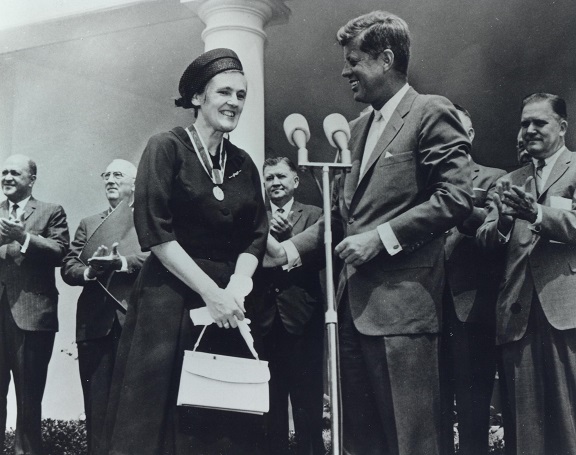
On August 7, 1962, U.S. President John F. Kennedy awarded Frances Kathleen Oldham Kelsey the President’s Award for Distinguished Federal Civilian Service.
Why was Kelsey so honored? Was it because she was a superstar Pop singer . . . an Oscar winning Hollywood actress . . . a Wimbledon Tennis champion?
Her acclaim stems from her steadfast dedication to public health and the well-being of society.
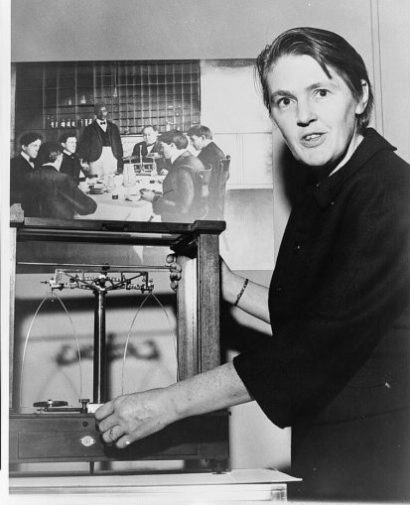
Frances Kelsey was born on July 24, 1914, in Cobble Hill, British Columbia, Canada. She pursued higher education at McGill University in Montréal, Quebec earning both a bachelor’s and a master’s degree in pharmacology.
In 1937, she began her doctoral studies at the University of Chicago, where she researched teratogens, drugs capable of causing birth defects, and how such defects occur.
During her graduate studies, Kelsey assisted her advisor, Eugene Geiling, on an investigation into the deaths caused by elixir sulfanilamide, a medication that had fatally poisoned 107 people.
This work revealed a fundamental gap in U.S. drug regulation and ultimately led to the Federal Food, Drug, and Cosmetic Act of 1938.
After earning her Ph.D and M.D., Kelsey joined the University of Chicago faculty, and later taught pharmacology at the University of South Dakota until 1957.
In 1960, Kelsey joined the U.S. Food and Drug Administration (FDA) as one of only seven full-time physicians reviewing new drugs.
One of her first major assignments was evaluating thalidomide, a drug marketed overseas as a sedative and treatment for morning sickness in pregnant women.
Kelsey withheld approval, rigorously requesting scientific data and clinical trials. She questioned the drug’s safety, noting incomplete reports and untested assumptions about its effects on fetuses.
In the face of immense pressure from its manufacturer, she stood firm . . .
Then, thousands pregnant women in Europe and Canada who had taken thalidomide gave birth to babies with birth defects. The drug was immediately banned in the United States.
Her diligence and efforts helped bring about the Kefauver-Harris Amendment of 1962, which strengthened drug safety laws, required efficacy testing, and mandated reporting of adverse effects.
Kelsey continued her work at the FDA for decades, shaping drug regulation and safety standards.
Dr. Frances Kelsey retired in 2005 at the age of 90, after 45 years of service. She passed away in 2015, in London, Ontario, at the age of 101.
In honor of her lasting impact on public heath, in 2010, the FDA established the Dr. Frances O. Kelsey Drug Safety Excellence Award.
Her legacy endures as a testament to scientific rigor, courage, and unwavering commitment to protecting human life.

Questions
Aspirin. Frances Kelsey was a famous TV sitcom star who won an MTV award. True or false?
Penicillin, Antibiotics. Was Kelsey Scottish?
Hot Tea with Honey and Lemon She studied computer science at Harvard University. Is this right or wrong?
Phytonutrients. Did Dr. Kelsey’s research focus on finding a cure for cancer?
Vitamins and Minerals. Is thalidomide an anti-depressant? Did she assess the effectiveness and safety of thalidomide at a university research laboratory?
Anthocyanins. Dr. Kelsey rushed to approve thalidomide because she was very busy and was promised a commission by the pharmaceutical company. Is this correct or incorrect?
Antioxidants. Was Dr. Kelsey recognized and honored?
Beta-carotene. Did she retire after the thalidomide case and party and live a lavish lifestyle?
Vitamin D. I have heard of Dr. Frances Kelsey. Yes or no?
Omega-3 Fatty Acids. Do you know of such heroes and heroines?
Lycopene. What do people think of the pharmaceutical industry (or “Big Pharma”)?
Sulforaphane. Are there (many) pharmacies or apothecaries?
Fiber. What might happen in the future?
Flavanols. What could or should people, governments and the pharmaceutical industry do?
